One of the greatest superhero movies of all time is Tim Burton’s Batman Returns, a bleak fantasia about three comic-book characters (Batman, Catwoman, and the Penguin) whose identities were forged in trauma, and whose costumed alter egos are exaggerated responses to that pain. Batman Returns came out in 1992, before the costumed-hero drama became Hollywood’s predominant genre. At the time, the movie’s protagonist, Bruce Wayne (played by Michael Keaton), still felt like a true oddity, a sad millionaire waiting in his empty mansion for a signal to be lit in the sky so that he could have permission to dress up as a bat again.
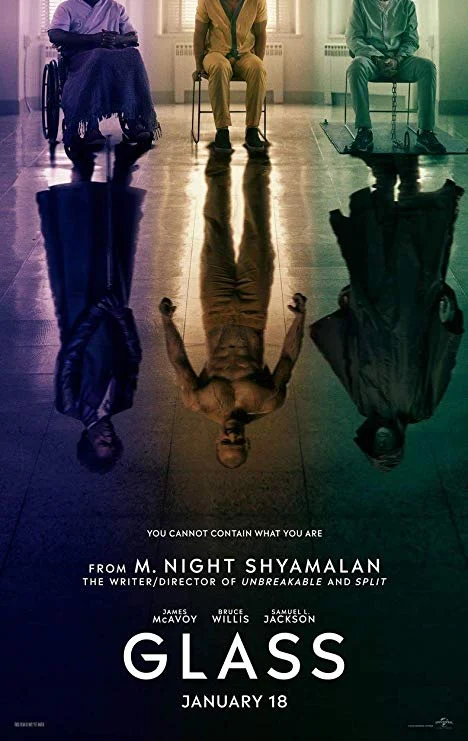
M. Night Shyamalan has always given his superheroes, and his supervillains, similar pathos. The director’s very strange makeshift trilogy—comprising Unbreakable (2000), its quasi-sequel Split (2017), and now Glass—is populated with people who filter their terrible pasts through exaggerated, pulpy personae, becoming comic-book characters who somehow exist in our real world. David Dunn (Bruce Willis), the protagonist of Unbreakable, is a taciturn man who realizes he’s invincible after surviving a horrifying train crash. Elijah Price (Samuel L. Jackson), his antagonist, is a brittle-boned evil genius called “Mister Glass” who engineered the crash in search of someone who is physically invulnerable.
Unbreakable was only a modest box-office hit, so whatever plans Shyamalan had for future installments were forgotten, and the director moved on to other projects, some (Signs) more successful than others (The Happening, Lady in the Water). But with Split, he deployed one of his most surprising twists yet. This cheaply made horror movie, about Kevin (James McAvoy), a man with multiple personalities who likes to kidnap and cannibalize cheerleaders, was actually a stealth sequel to Unbreakable, ending with a shot of an older David Dunn, getting ready to do battle with a new nemesis.
Split made some 30 times its budget, and so Shyamalan has delivered Glass, which unites David, Elijah, and the many-headed Kevin (dubbed “The Horde”), to face off against one another in a crossover that no one could have predicted. The result is a ponderously ambitious project that’s bound to infuriate all but Shyamalan’s most devoted fans, a 129-minute treatise on the nature of comic-book heroism and America’s seemingly unending fascination with these damaged champions. It’s a film that sometimes plays more as a rambling ted Talk than as a straightforward thriller. But, in this case, I admired Shyamalan’s overreach, even as the auteur laid meta-textual twist atop twist in the movie’s giddily loopy ending.
David, Elijah, and Kevin might not be the household names that Batman, Catwoman, and the Penguin were in 1992. But Shyamalan’s characters are all “broken” in one way or another, looking for some kind of purpose through the lenses of their alter egos. David resorts to vigilante justice, Elijah to mass murder, and Kevin to kidnapping people to satisfy “the Beast,” the most malevolent of his personalities. Horrified by these three disturbed Philadelphians, Dr. Ellie Staple (Sarah Paulson) has them all incarcerated and brought to a mental institution, where she can interrogate them together, trying to get to the bottom of what she thinks are just comics-fueled delusions of grandeur.
At first, Glass plays a little more like Unbreakable. It tries to stay as down-to-earth as possible, with Staple claiming there are perfectly rational explanations for David’s and Kevin’s feats of strength and Elijah’s murderous tendencies, all stemming from violence the men suffered as children. But that half of the film is at war with the half possessing the zanier tone of Split, which was dominated by a vamping McAvoy shuffling among a dozen identities (including a preening schoolmarm, a petulant child, and a raging animal) in one body.
What tone does Glass settle on? Silly or serious? It never really decides, just toggling between both, sometimes in the same scene. This is a film where Elijah can introduce himself by intoning “First name Mister. Last name Glass,” and simultaneously earn a laugh and a gasp. It’s a film that expects you to understand the intricacies of Kevin’s condition (if you haven’t seen Split since it came out, I’d advise brushing up on the basics), but also features a comic-book salesman who patiently explains to the audience that superheroes were largely invented with the release of Superman’s Action Comics in 1938. Glass is patronizing and broad while also feeling knotty and philosophical.
So why did I enjoy it so much more than the other 100+ critics? For one thing, I appreciate the sheer brashness of Shyamalan’s storytelling, which swirls the mythmaking inherent in characters such as David with the emotional scars borne by orphaned characters such as Superman. If Incredibles 2 was Brad Bird reckoning with America’s superhero obsession, Glass is Shyamalan taking up that mantle and coming away with the observation that, though these heroes might be “broken,” they’re also singular. The director clearly sees them as objects of daily fascination for a country looking to escape the mundane wherever it can; he’s just trying to understand why.
At the end of Glass, as Shyamalan starts to throw twists at the audience thick and fast, he posits that what’s really powering David and his enemies is public scrutiny—that what their superpowers really feed off is the adoration, and fear, of the masses. Shyamalan is not the first to make that connection, but he gleefully wraps that insight in a plain-seeming action sequence that is dripping in fairy-tale-like allegories. As the unbreakable David and the savage Kevin do battle in a field outside their asylum (a scene that’s leagues removed, in grandeur, from the multimillion-dollar celestial showdowns we might expect of a Marvel movie), Elijah sits nearby in his wheelchair, excitedly debating out loud all the plot implications of what might happen next. This sequence might sound tiresome, and it’s certainly bizarre to behold, but in a cinematic landscape drowning in superheroes, I’ve never seen anything quite like it.
7.5/10
